Research · ongoing
Co-design Framework for Legged Robots
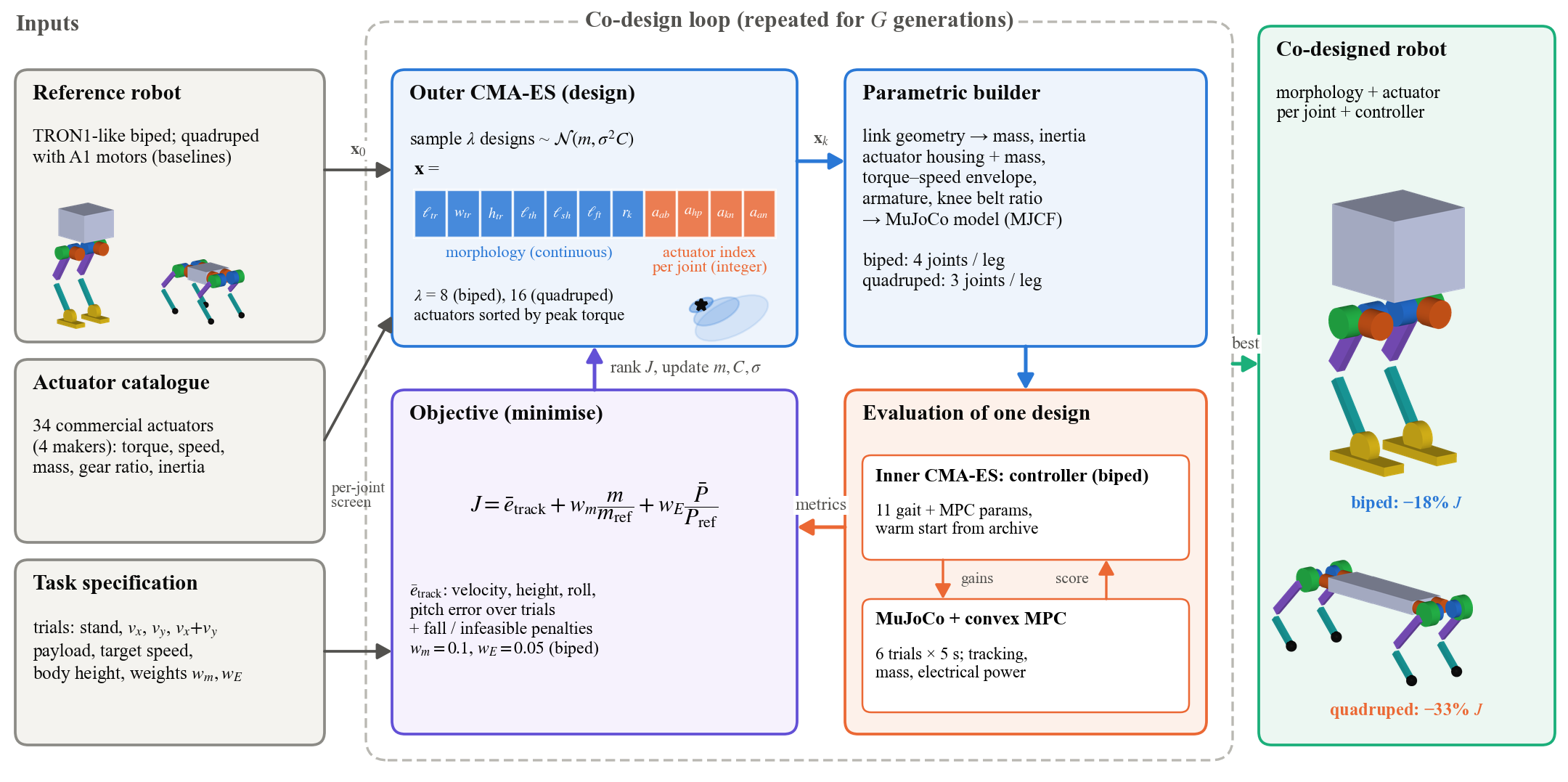
Most legged robots are designed one piece at a time. You pick the link lengths, put the same motor at every joint, and then tune the controller afterwards to make it walk. But the body, the actuators and the controller all depend on each other, so fixing them one by one leaves a lot on the table. In this project I search all three together. I wrote a parametric builder that takes a handful of numbers (trunk size, thigh, shank and foot lengths, knee belt ratio, and one actuator per joint picked from a catalogue of 34 commercial actuators) and turns them into a MuJoCo model with the right mass, inertia and torque–speed limits. A convex MPC controller then makes each design stand, walk forward, sideways and turn, and I score it on how well it tracks the commanded velocity and posture, how heavy it is, and how much energy it uses. CMA-ES sits on the outside: it samples a batch of designs, keeps the good ones and shifts its search toward them, generation after generation. For the biped I go one step further and give every design its own controller, tuned by a second CMA-ES inside the loop, so a good body doesn’t lose just because the gains were wrong for it.
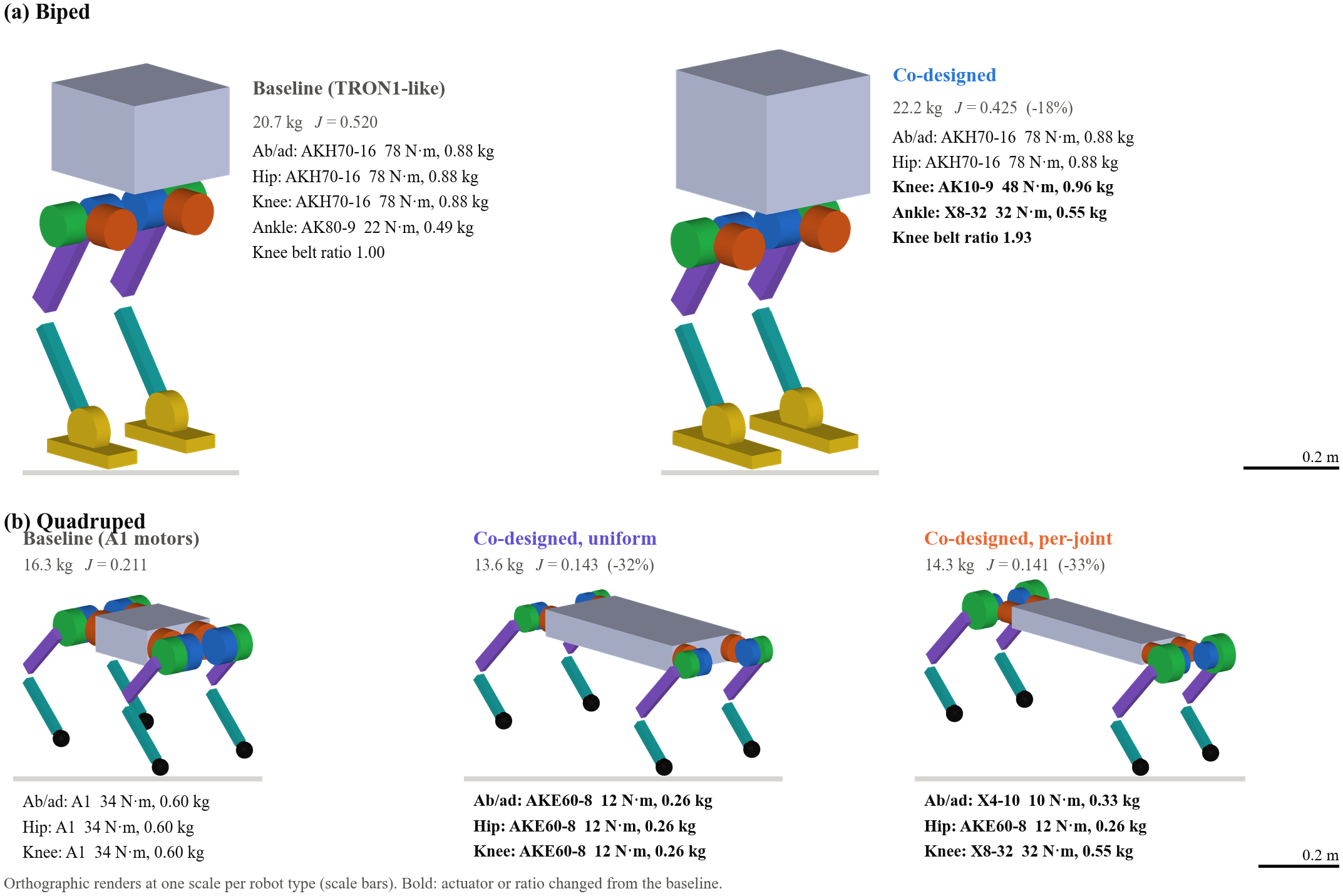
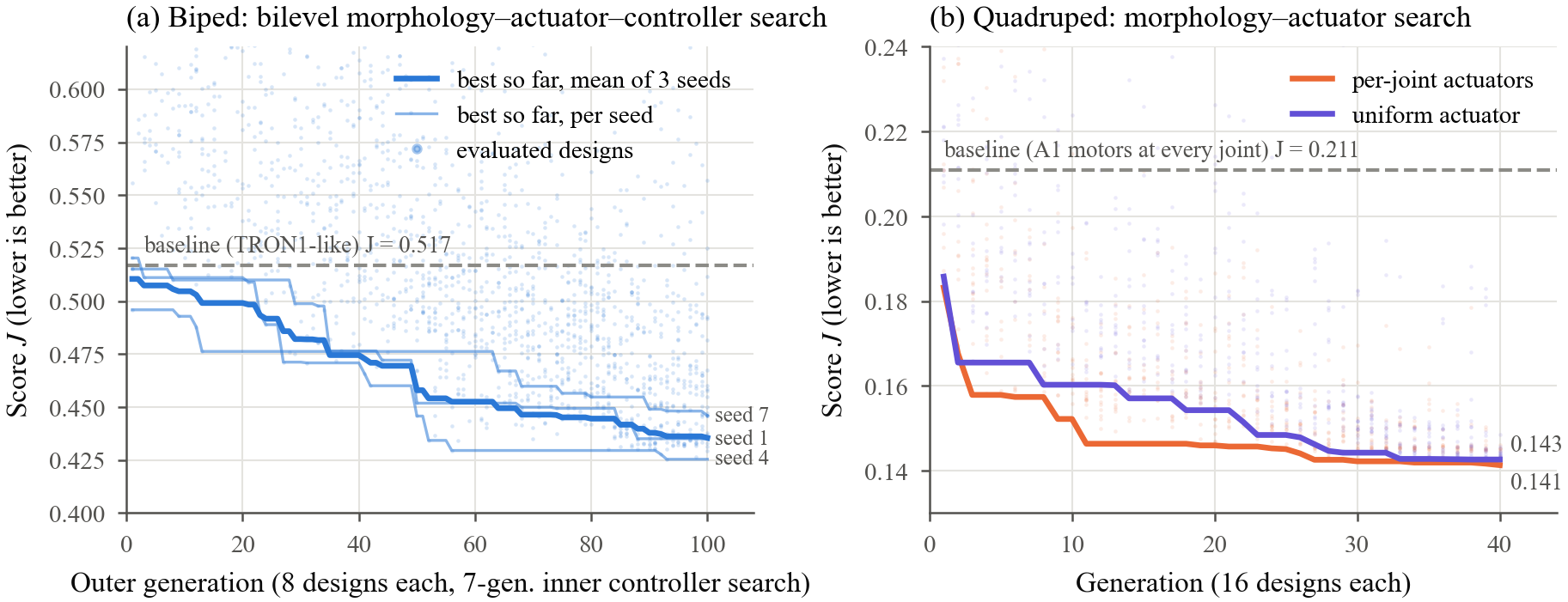
I ran this on two robots, a TRON1-like biped and a quadruped that starts with Unitree A1 motors at every joint. On the quadruped the search improved the score by 33%: tracking error dropped by about half and the robot got 12% lighter. What I like is what it chose. It didn’t put the strongest motor everywhere; it used small, light actuators at the ab/ad and hip, and a stronger one only at the knee, where the load actually is. The biped had a harder job, walking at 0.7 m height with a 5 kg payload at 0.8 m/s, and over three runs the co-designed robot scored about 16% better than the baseline, with tracking error down around a quarter and more of the commanded speed actually reached (82% vs 71%). The biggest lesson for me was how much the controller matters. A design that looks bad with fixed gains can turn out to be the best one once the controller is tuned for it, which is why the bilevel search is worth the extra compute.