Hardware · completed
Actuator Testbench
An actuator’s datasheet tells you what the motor should do. A dynamometer tells you what the whole actuator actually does once the gearbox, bearings, driver and thermal limits are involved. This testbench is the rig and software we used to get those numbers for the actuators we design and buy.
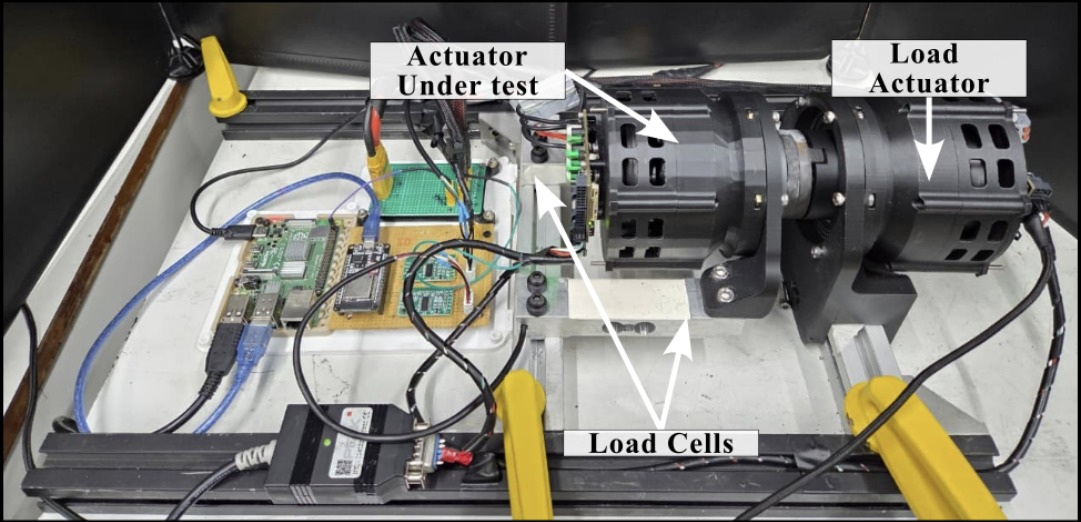
The rig
Two actuators sit back to back on an aluminium-extrusion frame with their output shafts coupled:
- Actuator under test: runs in torque control and applies the load.
- Load actuator: runs in velocity control and holds the speed.
- Load cells: measure the reaction torque at a known radius, giving an independent torque reading that doesn’t rely on the driver’s own estimate.
A Raspberry Pi runs the tests and talks to the drivers over CAN (pi3hat or fdcanusb for Moteus, SocketCAN for RMD). The load cells come in over serial.
For peak-torque and stiffness tests there is a second, vertical configuration with an RS485 static torque cell inline on the output:
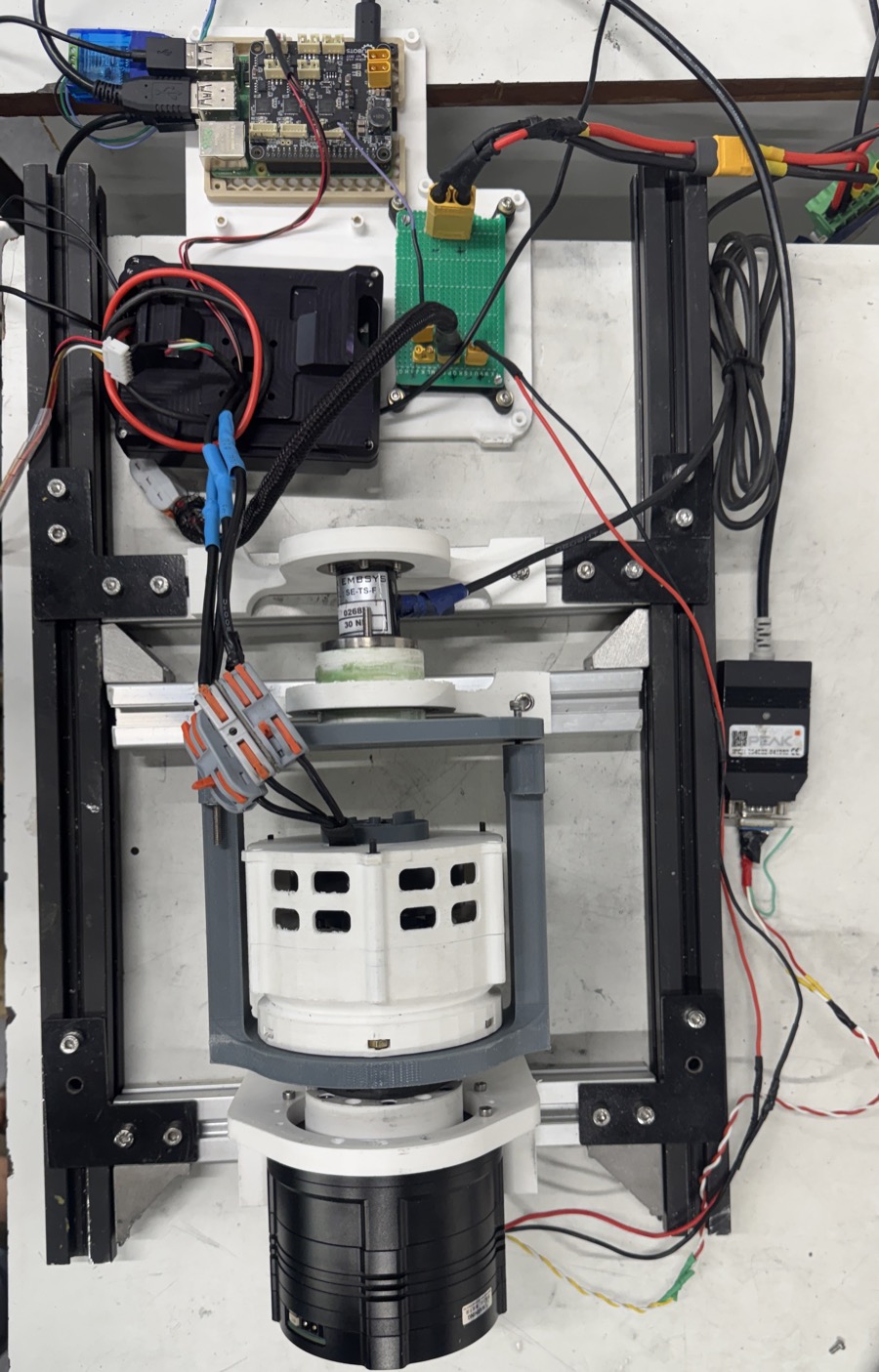
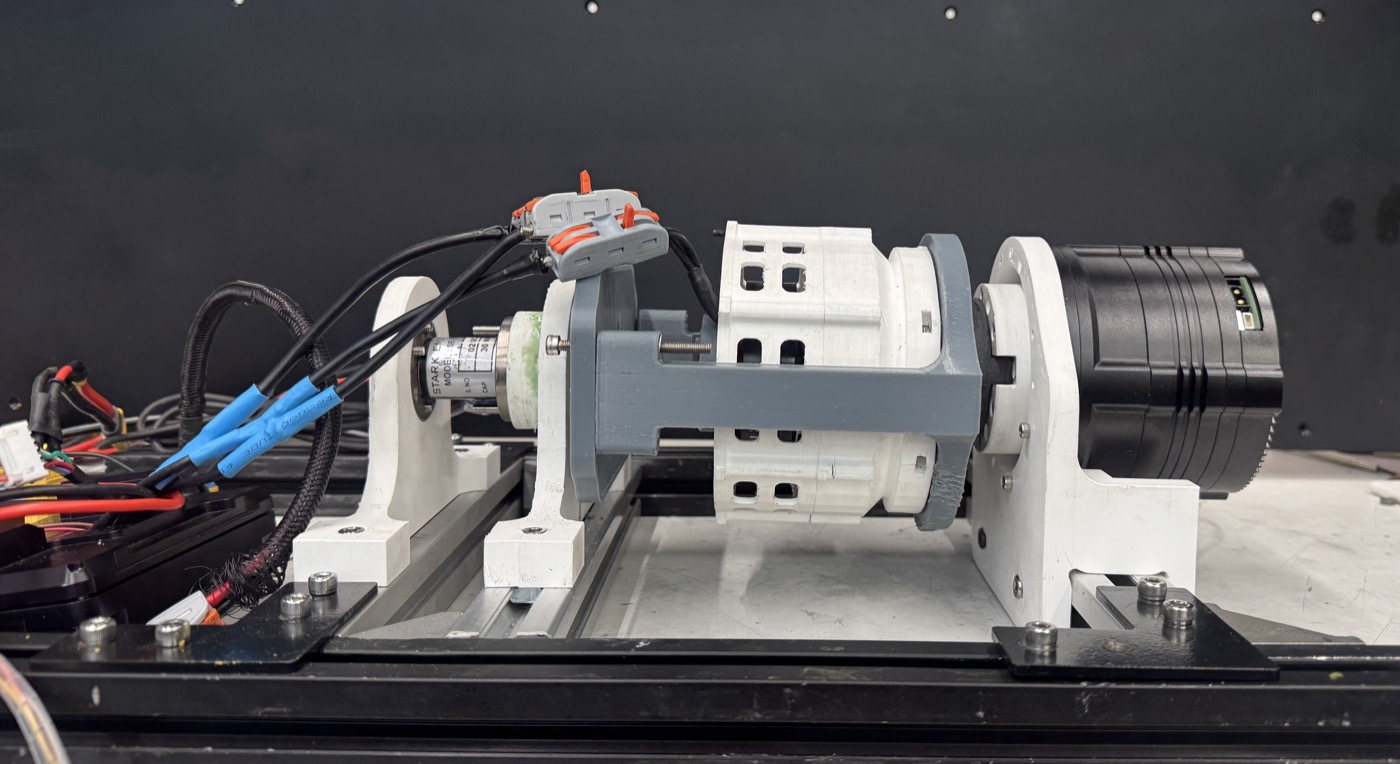
The test suite
Each test is a standalone Python script. You set the variables at the top (driver, CAN IDs, sweep range, output folder) and run it, and it writes one CSV per test point, ready for the plot scripts. It supports ODrive, Moteus and RMD drivers.
| Test | What it measures | How |
|---|---|---|
| Efficiency | Mechanical efficiency over a torque × speed grid | Sweeps torque and RPM setpoints, auto-tares before each point, compares measured to commanded torque |
| Peak torque | Maximum torque the actuator can sustain | Ramps up, holds, ramps down against a fixed output, read by the torque cell |
| Backlash | Dead band in the gearbox | Torque reversals with the output encoder zeroed by hand |
| Stiffness | Torsional stiffness and hysteresis | Slow torque sweep while logging output deflection |
| Endurance | Long-run reliability | Oscillates between two angles for a set time while you watch for noise and heat |
Example results: pancake vs. compound planetary
One comparison from the rig: two 14:1 gearboxes, a pancake planetary and a compound planetary (CPG), tested on the same motor.
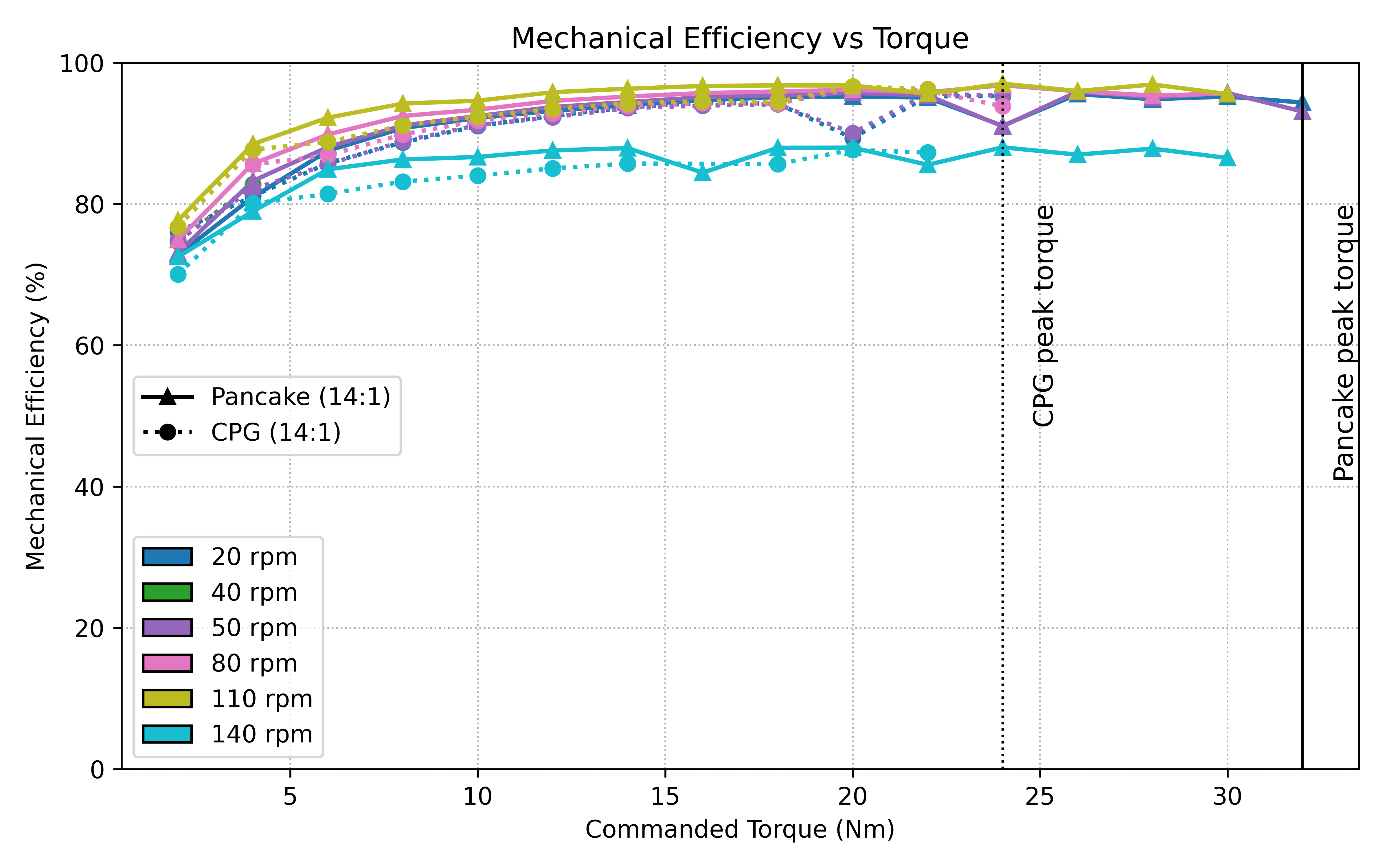
Both reach about 95% mechanical efficiency above roughly 12 N·m. Efficiency drops at light loads, where friction is a large fraction of the torque, and at the highest speed. The pancake gearbox also goes further: its peak torque is about 32 N·m, against about 24 N·m for the CPG.
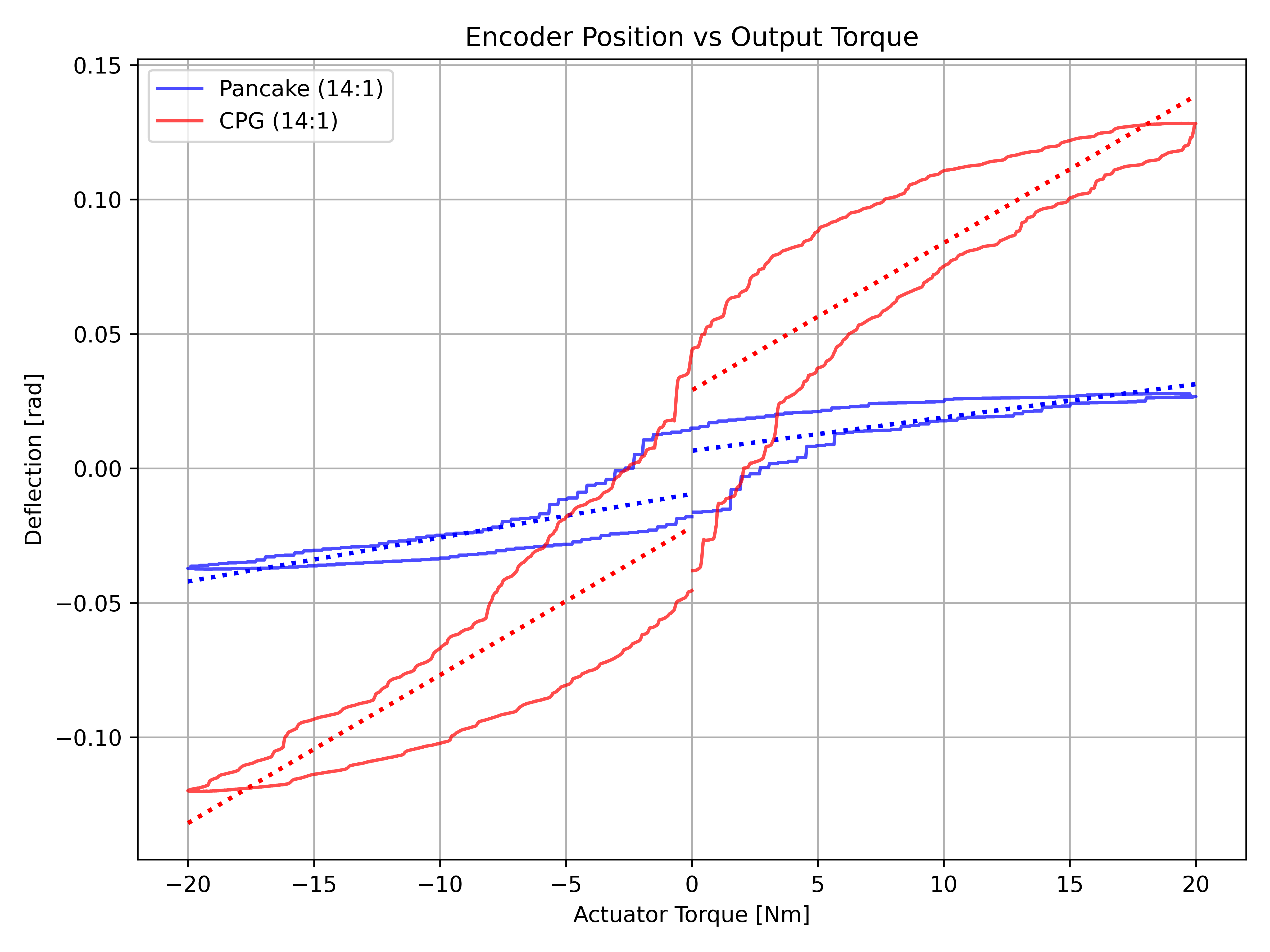
The stiffness test shows the bigger difference. Over ±20 N·m, the CPG deflects about four times more than the pancake gearbox and has a much wider hysteresis loop. For a legged robot, that is the difference between a leg that holds its position and one that feels soft.
The rig has since been used on a range of other actuators (MyActuator X6/X8, the VT8020, and several in-house planetary designs). The VT8020 efficiency sweeps are the dataset behind the Sim-to-Real inverse actuator model.