Research · completed
Actuator Gear-Train Optimization
Choosing gear tooth counts for a legged-robot actuator is a small but awkward optimization problem. The variables are integers, the constraints come from gear geometry (meshing, assembly, planet clearance, fitting inside the motor), and the cost depends on how the leg actually moves. KAIST published two papers that set this up as a mixed-integer nonlinear program (MINLP) and solved it with BARON, a commercial solver. I re-implemented both in plain Python.
The common trick: the geometry bounds every tooth count, so the feasible integer set is finite and fairly small. Enumerating it with vectorised numpy takes well under a second, and the answer is the certified global optimum, not just a local solution.
KAIST HOUND quadruped (hip + knee)
Based on Shin et al., Design of KAIST HOUND, a Quadruped Robot Platform for Fast and Efficient Locomotion with Mixed-Integer Nonlinear Optimization of a Gear Train (ICRA 2022).
The six decision variables are the sun, planet and ring tooth counts for the hip and knee planetary gearboxes. For a given gait, the code computes inverse dynamics on a planar 2-link leg, maps joint torques to motor torques (including reflected rotor inertia), and checks each design against:
- the motor’s voltage-limited operating region,
- the motor controller’s thermal limit from RMS current,
- the planetary assembly and packaging constraints.
The cost is the paper’s cost of transport, plus a small term that prefers smaller ring gears.
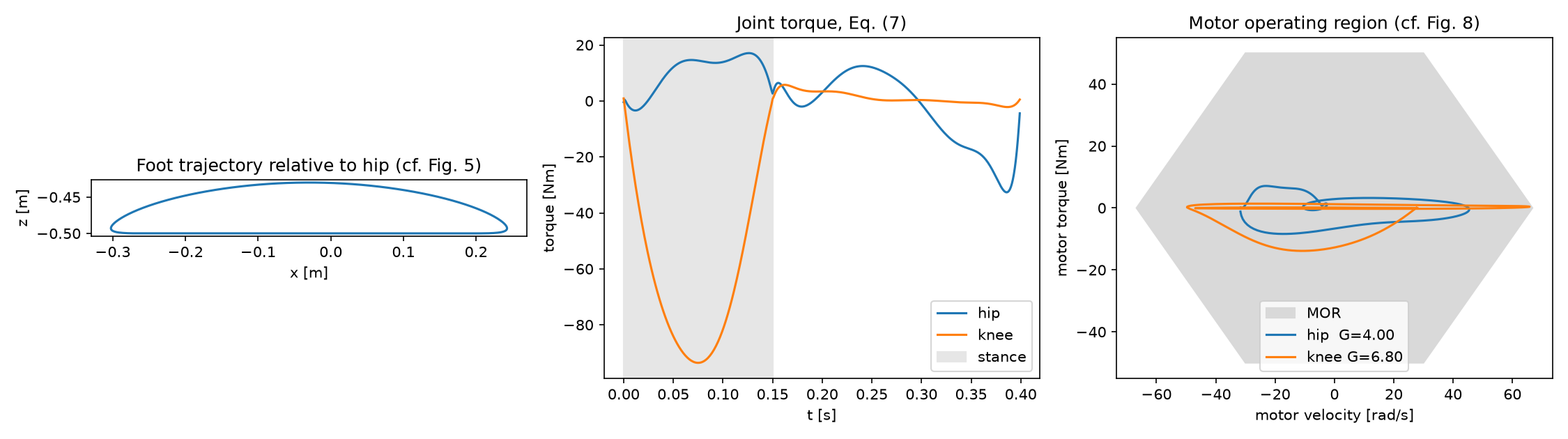
Results with my reconstructed gait:
- Hip: 26/26/78,
G = 4.00, the same as the paper. - Knee: depends on the swing trajectory. The motor’s speed limit and the controller’s heat limit
push the ratio in opposite directions. With an earlier swing profile the solver returned the
paper’s exact design,
[26, 26, 78, 18, 33, 84](G = 4.00 / 7.93).
You can pass in your own gait as a CSV, which matters when using this for real design decisions.
KAIST 3-DOF biped leg (knee + ankle)
Based on Choe et al., Design of a 3-DOF Hopping Robot with an Optimized Gearbox: An Intermediate Platform Toward Bipedal Robots (arXiv:2505.12231, 2025).
The knee uses a 3K compound planetary gearbox: an input sun, compound planets, a fixed ring and an output ring, for a 20:1 reduction in a very short package. The optimizer looks for:
- a large sun gear (to leave room for a hollow shaft),
- a fixed ring that fills the rotor bore,
- small everything else, to save mass,
all subject to an exact gear ratio, assembly, and carrier-post clearance. With D = 79.4 mm,
module 0.6 and G = 20, the default run returns the paper’s design
Z_S=44, Z_P1=44, Z_P2=32, Z_F=132, Z_O=120 with four planets.
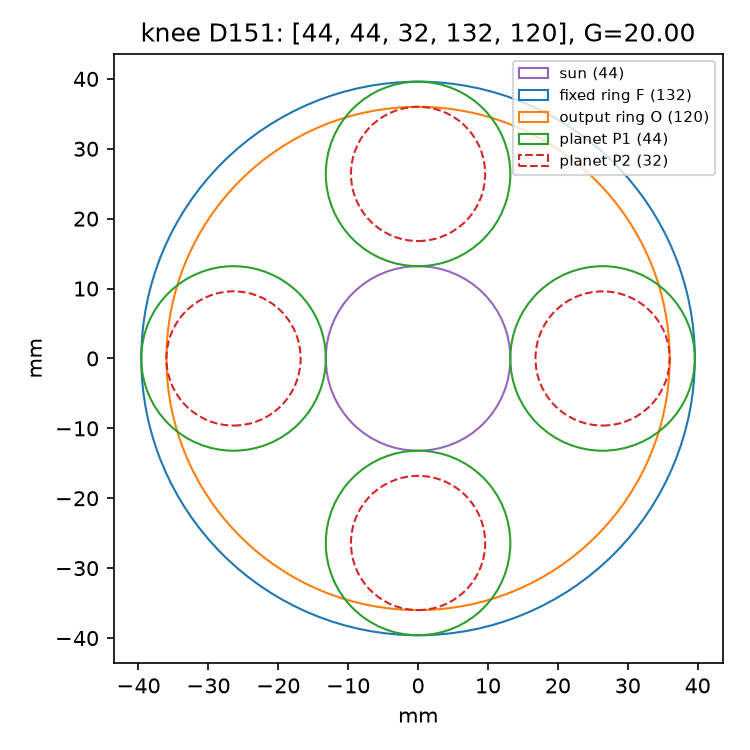
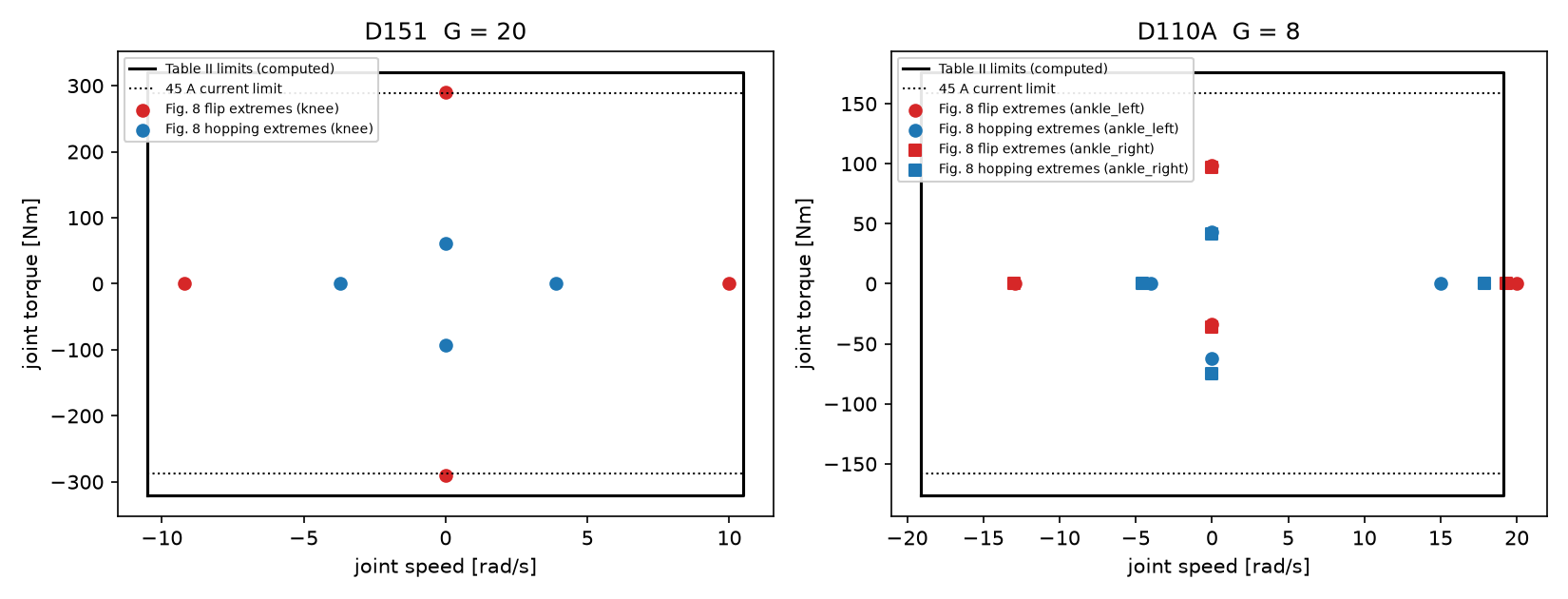
The paper says the 8:1 ankle gearbox was optimized too, but doesn’t give the formulation. I applied the same method reduced to a single planetary stage. A replication script also recomputes every number in the paper that can be reproduced, including the joint torque-speed limits against the hopping and flipping extremes from its Fig. 8:
Takeaways
- For gearbox-sized problems you don’t need a commercial MINLP solver. Bound the integers with the geometry, collapse the cost onto the gear ratios, and enumerate.
- Write down which parameters come from the paper, which are back-calculated and which are assumptions. Here, the knee ratio turned out to be sensitive to an unpublished detail: the swing trajectory.
- As printed, the paper’s equations alone allow designs that can’t be built. Adding coaxial meshing, a minimum planet size and planet-collision checks brings the solver back to the paper’s answer.